
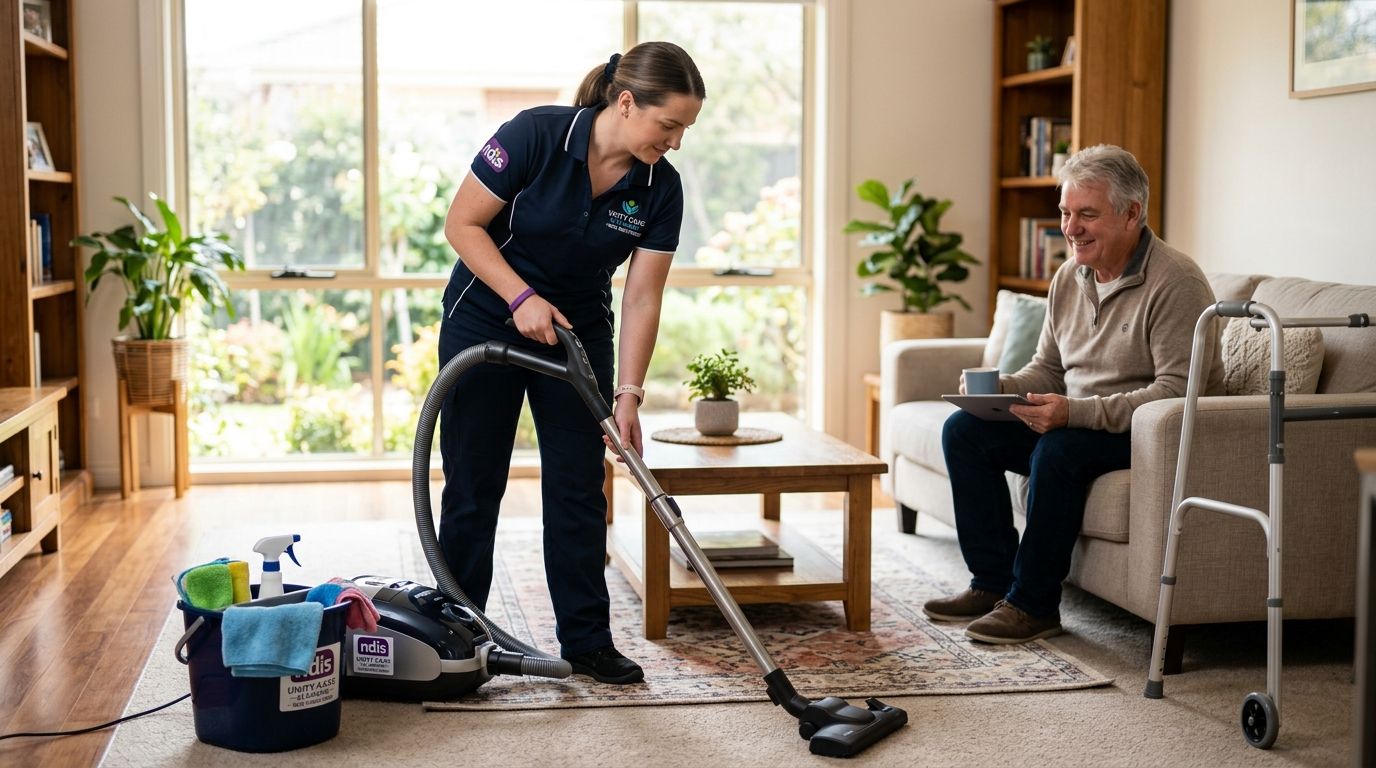
NDIS cleaning services are household cleaning supports funded through a participant's NDIS plan, arranged so a registered or non-registered provider carries out tasks the participant cannot safely or reasonably do themselves. Unlike a standard home clean, the scope, funding line and provider requirements are set by the NDIS Price Guide, so what gets covered and who can deliver it depends on how the plan is managed.
- NDIS cleaning services are funded under Assistance with Daily Life for participants who cannot safely clean their own home in 2026.
- NDIA-managed plans generally require a registered provider; plan-managed or self-managed budgets allow more flexibility.
- Naturo Group delivers NDIS, aged care, DVA and insurance cleaning across Australia using eco-friendly methods.
- Household tasks like kitchens, bathrooms and floors are usually covered; heavy home maintenance work usually is not.
- Compare at least two providers on service agreement terms before locking in a schedule.
Why NDIS cleaning services matter for participants
A cleaning task that takes an able-bodied person twenty minutes can be physically impossible or unsafe for a participant managing chronic pain, low mobility, fatigue or a cognitive disability. The NDIS recognises this through the Assistance with Daily Life support category, which covers everyday household tasks when a participant's disability stops them from doing these safely alone.
The catch is that funding under this category is not automatic and not unlimited. Participants who assume "NDIS covers cleaning" without checking their plan's line items often find out mid-service that the budget was never allocated, or that the task they wanted (say, carpet steam cleaning after a flood) sits under a different support category entirely.
Confirm your plan actually funds cleaning
Start here before contacting anyone. This step costs nothing and takes ten minutes with your plan document open.
- Look for "Assistance with Daily Life" or "Core Supports" in your NDIS plan budget
- Check whether your plan is agency-managed (NDIA-managed), plan-managed, or self-managed
- Ask your Support Coordinator or Local Area Coordinator to confirm cleaning is an approved line item
- Note your remaining Core Supports balance and how often it renews
- Check if the funding covers ongoing cleaning or a one-off service
Work out which tasks are actually covered
NDIS cleaning funding is narrower than most people expect. It covers routine household tasks tied to daily living, not property upgrades.
- Kitchen, bathroom and living area cleaning
- Floor cleaning, vacuuming and mopping
- Laundry, linen changes and bed making
- Bin management and general tidying
- Tasks are usually excluded when they fall under Home Modifications or Assistive Technology instead of Assistance with Daily Life
Check whether you need a registered provider
This is the step that trips up the most participants, and it depends entirely on how your plan is managed.
- NDIA-managed plans generally require you to use an NDIS-registered provider
- Plan-managed and self-managed budgets give you the choice of registered or non-registered providers
- Ask any prospective cleaner directly whether they are NDIS-registered and for which support categories
- Request written confirmation of registration status before signing a service agreement
- Confirm the provider can invoice in the format your plan manager requires
Choose a provider that matches your support needs
Once you know what's funded and who can deliver it, compare providers on how they actually work with NDIS participants, not just on availability. Naturo Group runs NDIS cleaning services alongside aged care, DVA and insurance cleaning across Australia, using eco-friendly products and methods, which matters if a participant has chemical sensitivities or respiratory conditions.
- Ask how the provider handles service agreements and cancellation notice
- Check if staff have experience working in homes with mobility aids, medical equipment or sensory needs
- Confirm cleaning products used, especially if fragrance or chemical sensitivity is a factor
- Ask about consistency of staff, since participants often rely on familiar faces
- Request a clear breakdown of what's included per visit
Set a cleaning schedule that matches your funding
A schedule that outpaces your budget causes services to stop mid-plan, which is disruptive for participants who rely on consistency.
- Match visit frequency (weekly, fortnightly, monthly) to your remaining Core Supports balance
- Build in a buffer before your plan review date so funding doesn't run out early
- Flag any planned hospital stays or respite periods that would pause service
- Confirm how rescheduling works around medical appointments
Track and review the service
Ongoing NDIS cleaning services should be reviewed, not set-and-forget, especially when a plan renews or care needs change.
- Keep a simple log of what was done each visit
- Raise issues with the provider directly before escalating
- Review the service agreement at each plan renewal
- Change providers if the scope no longer matches your needs
Comparing your cleaning options
| Option | Best for | Key limitation |
|---|---|---|
| NDIS-registered cleaning provider | Participants on NDIA-managed plans | Fewer providers to choose from in some regions |
| Non-registered private cleaner | Plan-managed or self-managed participants wanting more choice | Cannot be used if your plan requires registered providers |
| Informal support (family or support worker) | Light, occasional tasks alongside paid supports | Not a substitute for a formal, funded cleaning arrangement |
| DIY cleaning by the participant | Tasks that are safe and manageable independently | Not viable when disability prevents safe or regular cleaning |
Check if your plan covers cleaning
Naturo Group arranges NDIS cleaning across Australia with eco-friendly methods.
Common mistakes NDIS participants make
- Assuming all cleaning is covered. Household tasks under Assistance with Daily Life are funded; heavy maintenance and one-off deep cleans after damage often sit under a different category.
- Skipping the registration check. Booking a non-registered cleaner on an NDIA-managed plan means the invoice can't be processed, and the service has to be redone with a registered provider.
- Scheduling without a funding buffer. Weekly visits that drain the Core Supports budget three months before plan review leave participants without cleaning support for the rest of the cycle.
- Relying only on informal support. Family and support workers can help, but leaning on them entirely instead of using NDIS cleaning services from a provider like Naturo Group can leave gaps when that person is unavailable.
- Not reviewing the service agreement at plan renewal. Needs change year to year; a cleaning arrangement set up in 2024 or 2025 may no longer match a 2026 plan.
FAQ
What are NDIS cleaning services?
NDIS cleaning services are household cleaning supports funded through a participant's plan under Assistance with Daily Life, delivered by a registered or non-registered provider depending on how the plan is managed. They cover routine tasks like kitchens, bathrooms, floors and laundry.
Does the NDIS pay for house cleaning?
The NDIS can fund house cleaning through the Assistance with Daily Life category when a participant's disability prevents them from safely cleaning their own home. Funding depends on the individual plan and is not automatic for every participant.
Do I need a registered provider for NDIS cleaning?
If your plan is NDIA-managed, you generally need an NDIS-registered provider for cleaning services. Plan-managed and self-managed participants have more flexibility to use registered or non-registered cleaners.
How often can I get NDIS cleaning services?
Frequency depends on your remaining Core Supports budget and what your plan approves, whether that's weekly, fortnightly or monthly visits. Setting a schedule that outpaces your funding causes services to stop before the plan renews.
Can family members provide NDIS-funded cleaning?
Informal support from family or friends can supplement cleaning but is not typically a formal, funded NDIS support. Participants relying only on informal help risk gaps in service when that person is unavailable.
Is NDIS cleaning different from a regular house clean?
Yes. NDIS cleaning is tied to a participant's plan, subject to registration rules and specific task coverage, whereas a regular house clean is a straightforward paid service with no funding restrictions.
What tasks are excluded from NDIS cleaning support?
Home maintenance work like repairs, gardening and structural cleaning after damage usually falls outside Assistance with Daily Life and may need a different NDIS support category. Routine household tasks are what's covered.
How do I switch NDIS cleaning providers?
Review your current service agreement, confirm your plan management type still applies, then arrange a new agreement with the incoming provider before your next scheduled visit. Providers like Naturo Group can confirm registration status and start dates directly.
One last thing
The distinction NDIS participants overlook most often isn't provider registration, it's the line between "household tasks" and "home maintenance." A cleaning visit that includes wiping down surfaces and vacuuming sits under Assistance with Daily Life, but the same visit extended to steam-cleaning carpets after water damage can shift into a different support category with different approval rules. Ask your provider to flag which parts of a job fall where before the invoice goes to your plan manager, not after.


