Fragrance-free, VOC-free and allergen-targeted natural cleaning products cut respiratory triggers better than conventional sprays — but which ones actually work depends on the task. Best overall for allergy and asthma sufferers in 2026: a professional eco-friendly cleaning service for consistent allergen control. Best DIY option: white vinegar and water. Best budget option: bicarbonate of soda.
- A professional eco-friendly cleaning service wins overall for consistent allergen control in 2026, especially for NDIS, aged care and rental properties.
- White vinegar and water is the best natural cleaning product for allergy sufferers on a DIY budget.
- HEPA-filter vacuums capture particles as small as 0.3 microns — standard vacuums recirculate them.
- Fragrance-free, enzyme-based laundry detergent cuts dust mite allergen load in bedding better than scented alternatives.
Why this matters
Conventional cleaning sprays list chlorine, ammonia, quaternary ammonium compounds and synthetic fragrance on the label — all documented respiratory irritants. For someone with asthma or allergic rhinitis, the wrong cleaning product doesn't just fail to help; it triggers the exact symptoms cleaning is meant to prevent.
The fix in 2026 isn't a single magic bottle. It's matching the right natural product — or the right professional service — to the right task, and knowing where DIY natural cleaning genuinely falls short of allergen removal. Naturo Group builds eco-friendly cleaning routines around exactly this problem for households, tenants, landlords, NDIS participants, aged care recipients and DVA clients across Australia.
What makes the best natural cleaning product for allergy sufferers
- No synthetic fragrance or VOCs — fragrance is the single most common asthma trigger in cleaning products
- No chlorine, ammonia or bleach residue that off-gasses into indoor air
- Proven against allergens, not just visible dirt — dust mites, mould spores, pet dander
- Low-rinse or no-rinse formulas so residue doesn't linger on surfaces kids or pets touch
- Clear, honest ingredient labelling — no vague "natural fragrance" green-washing
- Safe in enclosed spaces with limited airflow, like bathrooms and laundries
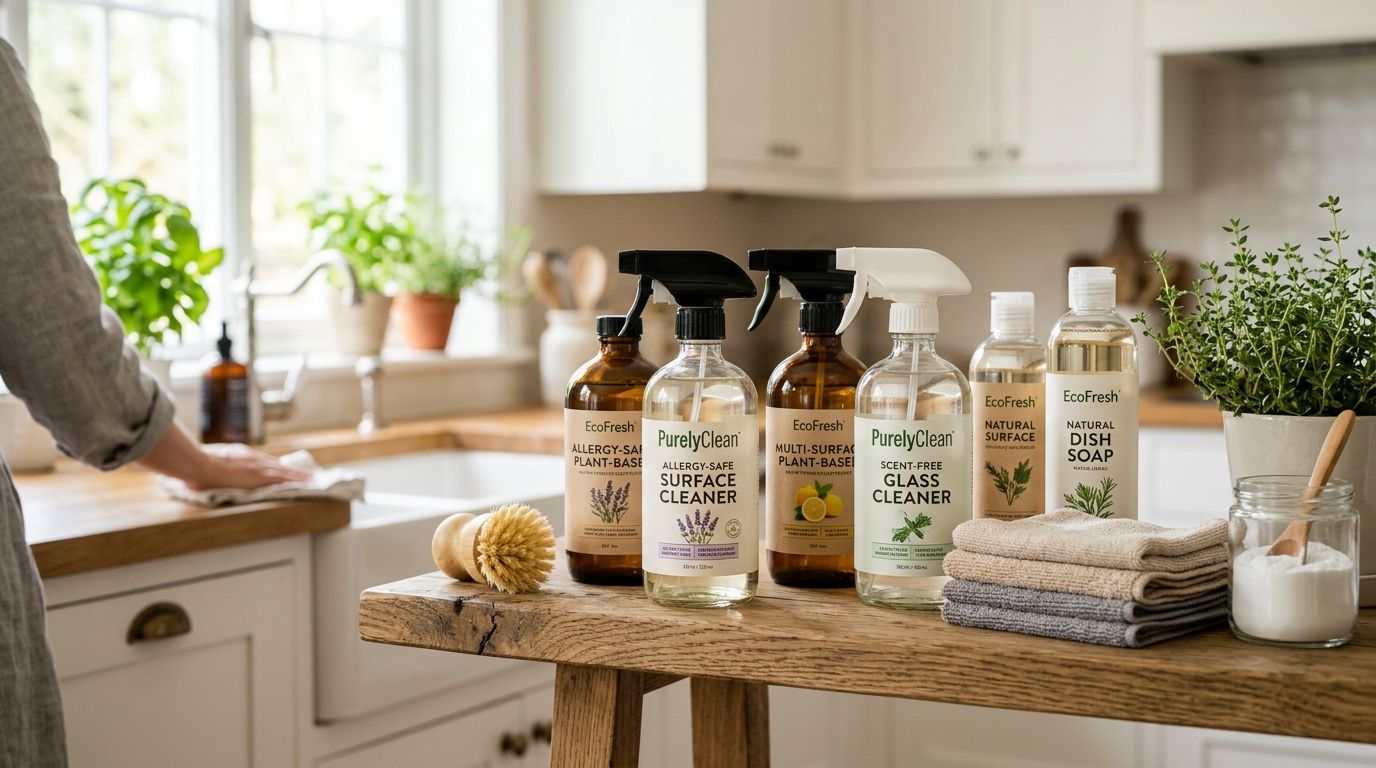
Natural cleaning options at a glance
| Option | Best for | Standout feature | Key limitation |
|---|---|---|---|
| Professional eco-friendly cleaning service | Ongoing allergen control | Consistent, trained technique across the whole home | Costs more than DIY and needs scheduling |
| White vinegar and water | Budget glass and surface cleaning | Cuts grease and mineral buildup with zero fumes | Won't cut heavy grease or disinfect against mould alone |
| Bicarbonate of soda | Fragrance-free abrasive scrubbing | Deodorises without masking odour with fragrance | Slow on baked-on grime, needs elbow grease |
| Castile soap | Gentle multi-surface and floor cleaning | Plant-based, biodegradable, low residue | Can leave a film on hard water surfaces |
| Fragrance-free enzyme laundry detergent | Reducing dust mite allergens in bedding | Enzymes break down allergen proteins, not just dirt | Needs a hot wash cycle to be fully effective |
| Microfibre cloths and mop pads | Trapping allergens without chemicals | Physically lifts dust rather than pushing it around | Needs frequent, hot washing itself to stay effective |
| HEPA-filter vacuum | Carpets, rugs and upholstery | Captures particles down to 0.3 microns | Higher upfront cost than a standard vacuum |
1. Professional eco-friendly cleaning service: best natural cleaning option for ongoing allergen control
A professional eco-friendly cleaning service applies fragrance-free, low-VOC products consistently across an entire home — bathrooms, carpets, upholstery, high-touch surfaces — rather than relying on whoever has energy left after work to wipe down a kitchen bench. For allergy and asthma sufferers, consistency matters more than any single product: allergen levels climb back within days of a missed clean.
Naturo Group pros:
- Covers NDIS, aged care, DVA and insurance cleaning scenarios where consistent, documented allergen-safe cleaning is required
- Trained technique reaches allergen traps (skirting boards, vents, upholstery seams) DIY routines often skip
- Removes the physical exertion of deep cleaning for care recipients and older clients with limited mobility
Naturo Group cons:
- Recurring cost compared to a bottle of vinegar under the sink
- Requires booking and scheduling around the household
- Doesn't replace daily spot-cleaning between visits
Best for: households, tenants, landlords and care recipients who need reliable, hands-off allergen control rather than another product to manage.
Verdict: Buy — for anyone managing asthma, allergic rhinitis or a compromised immune system where allergen buildup is a real risk, a professional eco-friendly service is the most consistent option in 2026.
2. White vinegar and water: best DIY natural cleaning product for glass and surfaces
Diluted white vinegar (roughly one part vinegar to one part water) cuts through grease film, mineral deposits and everyday grime without leaving fragrance or chemical residue behind. It evaporates cleanly, which matters for anyone sensitive to lingering fumes.
Vinegar pros:
- Costs almost nothing and is available everywhere
- No fragrance, no VOCs, no rinsing required
- Works on glass, benchtops, and most sealed hard surfaces
Vinegar cons:
- The smell itself irritates some sensitive noses until it dries
- Not strong enough alone against established mould colonies
- Can dull natural stone if used undiluted or too often
Best for: everyday surface wiping on a tight budget.
Verdict: Buy — the default fragrance-free surface cleaner for 2026, with real limitations against mould and grease.
3. Bicarbonate of soda: best for fragrance-free abrasive scrubbing
Bicarb soda handles the jobs vinegar can't — baked-on grime, grout lines, oven interiors — through mild abrasion rather than chemical strength. It also absorbs odour instead of masking it with fragrance, which matters when synthetic scent is the trigger.
Bicarb soda pros:
- Zero fragrance, zero fumes
- Cheap and shelf-stable for years
- Doubles as a fridge and carpet deodoriser
Bicarb soda cons:
- Slow going on heavy grease without a paste and soak time
- Can scratch soft or polished surfaces if used dry
Best for: grout, ovens, and odour control without scent.
Verdict: Buy — the best budget option on this list for abrasive jobs.
4. Castile soap: best for gentle multi-surface and floor cleaning
Castile soap is a plant-oil-based soap, typically olive or coconut oil, diluted with water for general cleaning. It's biodegradable, low-residue, and one of the gentlest options for households with both allergy sufferers and pets.
Castile soap pros:
- Plant-based and biodegradable
- Gentle enough for daily floor and surface cleaning
- Widely available fragrance-free versions
Castile soap cons:
- Can leave a soap film in hard-water areas
- Not a disinfectant on its own
Best for: floors, benchtops and general wiping in allergy-conscious households.
Verdict: Buy.
5. Fragrance-free enzyme-based laundry detergent: best for reducing dust mite allergens in bedding
Dust mite waste is one of the most common indoor asthma triggers, and it lives in bedding, not on hard surfaces. Enzyme-based detergents break down the protein in dust mite allergens during the wash, rather than just removing visible dirt, and fragrance-free formulas avoid adding a second trigger back into fresh sheets.
Enzyme detergent pros:
- Targets allergen proteins directly, not just soil
- Fragrance-free versions avoid re-introducing a trigger onto bedding
- Works in a standard hot wash cycle
Enzyme detergent cons:
- Needs a hot wash to fully activate the enzymes
- Fragrance-free versions can be harder to find on supermarket shelves than scented ones
Best for: bedding, pillowcases and soft furnishings in a household with dust mite sensitivity.
Verdict: Buy.
6. Microfibre cloths and mop pads: best for trapping allergens without chemicals
Microfibre's split fibres physically grab dust and allergen particles instead of pushing them around the way cotton cloths do. Used dry or lightly damp, it needs no cleaning product at all for routine dusting.
Microfibre pros:
- Removes allergens with zero chemical input
- Reusable and cheap over time
- Works on every hard surface in the home
Microfibre cons:
- Loses effectiveness if not washed hot and often — a dirty cloth just redistributes allergens
- Can't disinfect or remove mould staining alone
Best for: daily dusting and surface wiping without any product at all.
Verdict: Buy.
7. HEPA-filter vacuum: best for carpets, rugs and upholstery allergen removal
True HEPA filters capture 99.97% of particles down to 0.3 microns — the size range that covers dust mite debris, pet dander and mould spores. A standard vacuum without HEPA filtration often blows fine allergen particles straight back into the air through the exhaust.
HEPA vacuum pros:
- Removes allergens a cloth or mop can't reach, from carpets to upholstery
- Genuine filtration standard (0.3 micron capture) backed by decades of public health data
- Reduces re-circulated dust compared to a standard vacuum
HEPA vacuum cons:
- Higher upfront cost than a basic vacuum
- Filters need regular replacement to keep performing
Best for: carpeted homes and households with pets or dust mite allergies.
Verdict: Buy — the single highest-impact equipment purchase on this list for airborne allergen reduction in 2026.
“If a cleaning product needs a warning label for ventilation, it doesn't belong in a home with asthma.”
How this list was ranked
Every item on this list was measured against the six criteria above: fragrance and VOC content, chemical residue, proven action against allergens (not just dirt), rinse requirements, label honesty, and safety in low-ventilation spaces. Items that only clean visible mess without addressing dust mites, mould spores or pet dander ranked lower, even when they're popular natural options in 2026.
Get an allergy-safe clean booked in
Eco-friendly cleaning for homes, NDIS, aged care and DVA clients across Australia.
Which natural cleaning option should you choose?
For daily wiping on a budget, white vinegar and water does the job with zero fumes. For dust mite control in bedding, an enzyme-based fragrance-free detergent beats any spray. For airborne allergen reduction, a HEPA vacuum outperforms every wipe-on product on this list. But for households managing asthma, allergic rhinitis, NDIS support needs or aged care requirements where consistency can't slip, a professional eco-friendly cleaning service remains the best overall choice in 2026 — it combines all of the above into one routine instead of leaving allergen control to whichever product is left in the cupboard.
FAQ
What is the best natural cleaning product for allergy sufferers?
White vinegar and water is the best budget DIY option, while a professional eco-friendly cleaning service is the best overall choice for consistent allergen control in 2026. Both avoid the synthetic fragrance and VOCs found in conventional sprays.
Are natural cleaning products actually better for asthma?
Yes, when they're fragrance-free and VOC-free, because synthetic fragrance is one of the most common asthma triggers in cleaning products. Products that still contain "natural fragrance" or masking scents can still trigger symptoms.
Does vinegar kill mould and dust mites?
Diluted vinegar can slow surface mould and cuts grease and mineral buildup, but it's not strong enough alone against established mould colonies. Dust mite allergens live mainly in bedding and carpet, not hard surfaces vinegar reaches.
Is a HEPA vacuum worth it for allergies?
Yes — true HEPA filters capture 99.97% of particles down to 0.3 microns, which covers dust mite debris, pet dander and mould spores. Standard vacuums without HEPA filtration often recirculate those particles back into the air.
How often should bedding be washed for dust mite allergies?
Weekly in a hot wash cycle with a fragrance-free, enzyme-based detergent gives the best allergen reduction. Enzymes break down the allergen protein itself, not just visible dirt.
Is castile soap safe for asthma sufferers?
Fragrance-free castile soap is one of the gentler options for general surface and floor cleaning, with low residue and no VOCs. It isn't a disinfectant on its own, so it won't address mould or bacteria buildup.
Should I hire a professional cleaner if I have asthma?
A professional eco-friendly cleaning service applies fragrance-free, low-VOC products consistently across the whole home, which matters more for allergen control than any single product. This is particularly relevant for NDIS, aged care and DVA clients who need documented, allergen-safe cleaning routines.
What ingredients should allergy sufferers avoid in cleaning products?
Chlorine, ammonia, quaternary ammonium compounds and synthetic fragrance are the main respiratory irritants to avoid in 2026. Vague labelling like "natural fragrance" often hides the same synthetic scent compounds.
One last thing
Microfibre cloths only work as an allergen tool if they're washed hot and often — a cloth used for a week straight stops trapping dust and starts redistributing it across every surface it touches. That single habit change costs nothing and does more for allergen control in 2026 than switching to a pricier natural spray.